

Payment and point member | Payment methods | Shipping methods | Warranty policy | Shopping procedure


|
Kaitai Shinsho. vol.12 Orton MC cartridge MC20. Description, Kenji Kondo and Hiroyuki Satake, photography, Hiroyuki Satake. If we hear a cartridge, we think of the analog heyday age, And it is impressed as it was a good time. The ortofon MC20 was well received for the 1970s of the analog heyday. It can attach also in the universal arm and I hear that it was very popular at that time. Moreover, it is the conscience of an ortfon that the price of it is comparatively easy to buy. I hear that it was delicate and was developed for Japanese audio fans. (Kondo). It is Kaitai Shinsho after a long time. This time we disassembled the junk cartridge of the Ohsu head shop stock, the MC cartridge Ortfon MC20. Since it had converted, although there may be somewhat different at the actual MC20 This time, please understand. This time, it became Kaitai Shinsho which challenged close-up photography of a digital camera, and the limit of zoom. (Satake) |
|

|
|
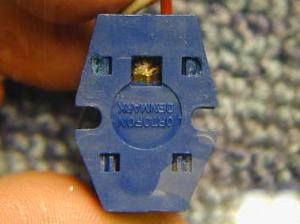
|
How to open a case first. See from the top, it has only adhered by four nails. It separates simply only by removing a nail. (Satake) |
|
If we take a case inside is like this. It is very simple. (Satake) |

|

|
If we remove the screw of middle, a main part will separate from a case. (Satake) |
|
Since magnetism is quite strong, it has attached, even if it removes a screw. (Satake) |

|

|
They are a screw and pole piece. Pole piece becomes S pole and the magnet has become N pole. (Satake) |
|
The screw has stopped with the nut attached to the case side. (Satake) |

|

|
The main part which removed the case is like this. The structure is almost the same as that of SPU. (Satake) |
|
When pole piece is removed like this. The needle has broken. Back pole piece and a back magnet are pasted up with adhesives. (Satake) |
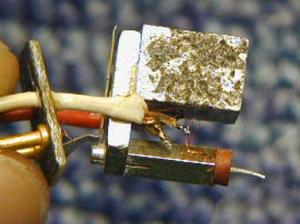
|

|
If we see from the bottom, you can see the small screw is attached. Seemingly this screw is a screw for stopping a string cylinder. It is very small screw. (Satake) |
|
Even if it removed this screw, the needle did not separate. (Satake) |

|

|
If you remove front pole piece and see from before, it will have become like this. Although there is no hole in a magnet and a screw seemingly passes along the bottom of a magnet in case of SPU, MC20 passes along the inside of a magnet. (Satake) |
|
It is the up of the part of a coil. The coil is wound around the type of "#" It seems that it is taking charge of right and left each channel in two diagonal sequences. We can see that the four thin coil thin has come out from the back of a damper. (Satake) The output voltage of MC20 was 0.1mV. After that, it was set to MC20MK2 and has been improved one after another, and At last, of the highest performance MC20 SUPER2 was appearing in 1987, And MC20 series rounded off the analog heyday age. "MC20S" is put on the market, that is the 6th generation of MC20, And the output is also large with 0,5mV now. (Kondo) |

|

|
It is near the drawer line of a coil. The thin coil has come out from between the dampers of rubber. (Satake) |
|
Just see from the left. (Satake) |

|

|
Back has become like this. A thin board is behind back pole piece, and this is connected to the right ground. It does not paste up but is only touched. (Satake) |
|
It photographs from another angle. The griddle is bent and the terminal is pasted as it is. (Satake) |

|

|
The terminal has become like this. + Side of both channels is converted and it is changed to the cable. (Satake) |
|
You can find out well if you see this photograph it is connected. (Satake) |

|

|
See the body from the top. (Satake) |
|
See from the bottom. Satake) |

|

|
Although there is a hole which attaches a needle cover in the side of a body, there are three. (Satake) |
|
It is near the ceiling of a body. The angle is already attached with the body. (Satake) |

|
|
Unexpected demolition of MC20 is easy. It was serious not to lose the disassembled part and to have taken a photograph. Although it is only a magnet, a coil, and a needle fundamentally, The sound is different Does it come from the difference in structure, the difference in a material, etc.? And I thought that the skill of the craftsman who makes a fine coil and adhesion like this influenced sound. I think that many things that is not see by the eye were stuffed. Demolition of a cartridge was good study for me and it was good. Next week I will also disassemble another cartridge. (Satake) Compared with the present CD, probably as for the merit of a far troublesome analog record, there is little distortion at the time of a small level, If set to a large level, distortion will increase with steps. This is because it has agreed for man's hearing physiology. It is said that the cartridge put on the market in Japan until now is close to about 1000. The cartridge of music and audios, especially the sound quality of MC type was good, and it was quite expensive compared with CD player etc. If it sees in business, added value of a cartridge is high and was sold at a cheaper price. I think that the reason that is expensive was that the market scale has been reduced double or more compared with the first half of 1970 - the 80s of the analog heyday. After this, at the time of the appearance of CD, Discontinuance of business of a cartridge maker succeeded one another. Material and a part maker also gave up their business. (Kondo) |
|
 Used
Used Consigned
 Hold
Hold Reserved
 Sold Out
-
-
- Company profile
- Privacy policy
- Contact
- Newsletter back issues
- Hi-Fi Do live camera!
- Today's software
- Today's hardware
- New arrival alert system
- Japanese
-
Hi-Fi Do Online Newsletter
-
Payment methods

-
Shipping methods

-
Warranty policy

-
Shopping procedure

-
Hi-Fi Do Record Shops Softs, Audio parts and Tubes can ship overseas.Ordinary,we use EMS but for large order,we use SAL or Surface.For Asia,it cost 1,200JPY/1LP,900JPY/1CD.Please check at the shipping cost table for more detail.

-
Meaning of icons
