

Payment and point member | Payment methods | Shipping methods | Warranty policy | Shopping procedure



|
My Treasure - "Vacuum tube amp making course" By Otomeijin (September 9, 2005) Chapter 1: Have your eyes opened. Topics on the amplifier. (Part 1) I am going to employ an instruction method of "Kit assembly" which will lead you well as I introduced to you last time. I use a Sun Audio SV-2A3 single stereo main amp. The components packaged in this amp kit are as follows: |

|
 |
|
Software: instruction manual for assembly, circuit drawing, wiring drawings (practical wiring drawings) 1 and 2, catalog (photos), etc. Hardware: component parts (chassis, cover, supporting metallic parts, screws, nameplate, etc.) electric circuit parts (vacuum tubes, transformer, condenser, resistor, changeable resistor, pilot lamps, etc.) connecting parts (AC outlet, sockets, switch, fuse, vacuum tube sockets, input pins, speaker terminals, lag terminals, lead wires, solder, etc.) The above photos show all the components of the kit. The red small boxes contain vacuum tubes. Note: In this kit, all the parts to be attached to the chassis are already attached to the chassis before delivery (See the right photo above). Look at the photo carefully to understand the structure so that you can attach those parts to the chassis by yourselves next time you make an amp. |
|
|
Next, I explain to you the concept of each component in turn in an easy-to-understand manner (I have attached as many photos as possible). Instruction manual for assembly: The manual shows features of this kit, items to be prepared, assembly process, confirmation and adjustment, notes, capability, etc. It differs diversely depending on the maker or the class. This manual is compact explaining mainly on the wiring. It would be better if the manual were more detailed about items to prepared, parts list, capability list, and the like. |
|
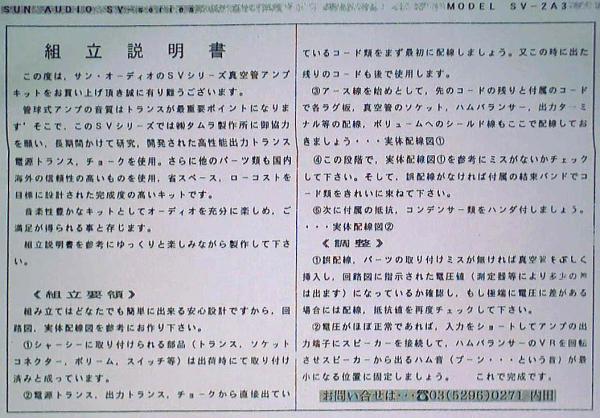
|
|
|
Circuit drawing: This is the most important design drawing that shows how to compose the electric device, which you want to make, from electric components. Figuratively speaking, it is something like a DNA record of an amp. The drawing indicates electric parts in codes, which I explain later on, connections, specific data, and the like. (See the photo.) This drawing is not wrong but is inadequate in terms of grounding as I explain later on. In addition, at least the power supply wiring of the other channel should be indicated because it is a circuit drawing of a stereo amp. I will supplement it in the chapter on practical trial. |
|

|
|
|
Wiring drawings (Practical wiring drawings): It is a picture or photo that visually shows based on the circuit drawing the positions to assemble parts, the order of wiring, aisles, and the like on a drawing of the real structure to be made. (See the photos.) On the wiring drawing ? on the left, I drew a black line along the grounding line. I will enlarge the photo in the chapter on practical trial. Incidentally, to watch the wiring drawings carefully is important for you to understand the structure of an amplifier, so do not say due to laziness, "I will do without assembling!" |
|

|
 |
|
Component parts: These are the parts for composing the structure to complete the electric circuit. Electric circuit parts: These are specific parts to get electric responses taken into account that naturally exist. Vacuum tubes: These are to get necessary responses (rectification and amplification) by applying a principle of thermion emission that thermions are emitted when metal is heated in vacuum. Let me explain in details because a vacuum tube amplifier is the theme of this course. A table is shown below, on which many features of a vacuum tube are placed in order. I have never seen the same explanatory table as this. (Hem! ...No, I just cleared my throat.) I put my ideas in order and tried to express them in an easy-to-understand manner. Then this table has come. Together with tube pin connection drawings, it might help you understand a tube amp. In the actual structure, however, an oval vacuum tube contains inside those components like an annual ring of a tree (concentrically) with a filament (heater) as a core. (My overkind advice: Print out this table and watch it carefully a few days, then you will become an expert?) |
|

|
|

|
|
|
Vacuum tubes has long supported our life and enjoyment, and it needs deep knowledge to understand them. So, I cannot tell you all about them. Therefore, let me explain about basic functions such as "rectification" and "amplification" next. * Rectification: If plus voltage is applied to the positive electrode of a diode tube, thermions created in the negative electrode are pulled to the positive electrode causing electric current to flow. (Note: Thermions are negative, so they are pulled to the positive electrode, while the electric current conversely flows from the positive to negative electrode. Do not forget this converse flow.) If ac voltage is applied to both positive and negative electrodes, electrons are emitted and electric current flows only while the positive electrode remains plus. This flow is only one-way with changed values. It is a completion of rectification (causing a flow of direct current, which is "one-way"). In this case, only plus half of alternating current is used. (Half-wave rectification): Make two positive electrodes and apply the voltage transformed by a transformer, then you can rectify another half as well using electric supply efficiently. (Full-wave rectification: See the circuit drawing): In general, you cause this direct current to flow through the smoothing circuit, then you will obtain stable direct current and use it at each part. * Amplification: If you put a network electrode (grid), through which thermions can flow, between the negative and positive electrodes in a diode tube, and change this voltage, the volume of thermions reaching the plate will change. Especially if you make the grid minus properly and apply signals to it, you can obtain the proportionally large signals at the plate circuit. It is as if you were changing the volume of water by opening or closing the water faucet. Or it is as if you were changing the speed (output) of a car by a slight motion of your ankle on the accelerator (grid). Finally, let me have a look at a single amp and a push/pull amp. At first, sound signals are elctrically moving to both plus and minus in alternating current. In case of a single amp, one output tube receives all sound signals between the two ends, and you can obtain the output based on the aforementioned amplification principle. (See the circuit drawing.) In case of a push/pull amp, basically two output tubes are pushed and pulled. One of them amplifies only plus signals, and another amplifies minus signals by inverting phases. You can synthesize them by an output transformer and obtain the output. In short, you use a single amp as if you were standing beside a swing swaying it with one hand, while you use a push/pull amp as if you were standing beside a swing swaying it forth with your left hand and back with your right hand. (Review the circuit drawing of the 6V6PP in my previous report titled "...more than a meal three times a day".) Therefore, (if the tubes are the same,) basically you can sway the swing in a wider range with both hands. A sumo wrestler could sway it more widely with one hand than I do with both hands. This is the difference of the structure of tubes. |
|

|
|
|
I forgot to tell you one thing. Now that we are in a age of semiconductors, integrated circuits and LSI (large-scale integration), are vacuum tubes still being produced? Can we obtain them? You may naturally be worried like that. At present, there are still many devices that need to use vacuum tubes, such as devices for broadcasting and military use, and microwave ovens for home use. So, at factories, they still have production facilities for vacuum tubes. Especially the ex-communist nations are big suppliers of vacuum tubes. Additionally those in dead stock are currently released. Furthermore, there still is worldwide demand for vacuum tubes for audio use. Therefore, you can get them at a specialty store, except for rare brands. Many vacuum tubes are sold at Hi-Fi Do Stores as well. Almost all the kits contain vacuum tubes so it is advantageous for you and let you feel at ease. We should be content with vacuum tubes having become a little bit expensive. The most expensive tubes of rarity value are exceptional. Part 1 is over now. I will talk about the other parts in Part 2 next week. To be continued. |
|
 Used
Used Consigned
 Hold
Hold Reserved
 Sold Out
-
-
- Company profile
- Privacy policy
- Contact
- Newsletter back issues
- Hi-Fi Do live camera!
- Today's software
- Today's hardware
- New arrival alert system
- Japanese
-
Hi-Fi Do Online Newsletter
-
Payment methods

-
Shipping methods

-
Warranty policy

-
Shopping procedure

-
Hi-Fi Do Record Shops Softs, Audio parts and Tubes can ship overseas.Ordinary,we use EMS but for large order,we use SAL or Surface.For Asia,it cost 1,200JPY/1LP,900JPY/1CD.Please check at the shipping cost table for more detail.

-
Meaning of icons
