

Payment and point member | Payment methods | Shipping methods | Warranty policy | Shopping procedure


|
My treasure - "Wrinkles like grooves bring audio wisdom" - 'Playing with speakers (Part 1)' By Otomeijin (Dec. 9, 2005) |
|
|
A speaker is audio equipment in the final stage that helps us listen to music. It is a system that receives electric signal and vibrates the air, and as you may know there are many types of it. I have actually touched and listened on such speakers as magnetic, dynamic, ceramic, and capacitor speakers. In my childhood when I got aware of what was good and wrong, I looked into the back of a pre-war radio and found out a magnetic speaker with a horseshoe magnet. A while after the end of the war, my family bought a new radio of the Mitsubishi Diatone, the speaker of which was a P-62F, predecessor of the famous P-610. This was a dynamic speaker with a magnet like an asphalt pitch solidified round (powder magnet which was a predecessor of ferrite?). Still at present, the mainstream speakers are dynamic speakers. Diaphragm materials and types of magnet may change, but there will be no other methods emerging in the near future that replace this converting method. Aside from this method, there will be only those methods which work more directly on our sense of hearing and the brain. (But it is questionable whether they will create hi-fi sound because they omit the process of air vibration.) |
|

|
Later on, I used a PE-8, PAX-12B and MH-300 of the Pioneer inside the speaker box, and I gradually became like an audiophile (got absorbed joyfully?). I still have the nameplate of the PIM-8 and an old advertising catalog. (Please see the photo.) The color of the nameplate is different from that of the insert. |

|
|
|
Commercial broadcasters began overnight radio broadcasting, and there was a radio program of famous classical music that was sponsored by King Record with explanation by Eihachiro Shitori. I remember the program started with the one-movement "The Autumn" of Vivaldi's "Four Seasons." This was an outstanding record in those days. Ordinary people in those days seldom stayed up late, but I really wanted to listen to the overnight program. So, I brought the table of my "KOTATSU" on the mattress, put the speaker without the box on the table, and finally covered all of them with a "KOTATSU" coverlet. I put my head under the table and listened on the speaker. It was an unaired space, but the sound was good while I was listening in the near sound field. I was able to listen to detailed nuance of the sound directly before it disappeared into space. It was so impressive. Probably there were headphones in the market at that time, but I remember there were not so many of them of high quality unlike now. I was just good at doing things in an easy and inexpensive manner. In my memory, the sound was great while I was listening with earphones (crystal receivers) of 100-yen coin size in the airtight space. Even now, the sound would be the best. |
|
|
I played with various speakers later on as well, and at the beginning of latter half of 1970's I got aware of the flat speaker which started to be known little by little. Until then, I had realized after trials and errors like this, "The so-called speaker making was almost to make a container! Of course making the speaker system but it was just woodworking. The real speaker making was to make a speaker unit. However, taking into consideration machines and magnet, it is impossible for amateurs to make the speaker unit." But with the emergence of the flat speaker, I thought I could play with it unless I did not seek an ideal flat speaker. That is to say, it was just enough for me to make the diaphragm by my own method. Thinking like that, I could not wait a minute and decided to obtain honeycomb aluminum at any rate. Although I did not remember how I searched, "Yokohama-Tire-Den" dealt with the honeycomb aluminum. I told them I would like to obtain it and they sold it to me on the minimum lot. Then I drove to the trading company in Akasaka to receive it. They said, "Honeycomb boards are used in the aircraft industry for walls and floors, while some people like you use it for speakers." (Please see the photo.) Incidentally, I took the box containing the honeycomb aluminum of about 1 square meter out of my room to take a picture of the honeycomb aluminum for this column and listened to a CD in the room. Then I felt the sound had become better. Though I had known it was not good to put junk inside an audio room, I had kept the large box there because there was no other place to place it in. How bad! But thanks to this column, I was able to get better sound. |
|

|
|
|
I purchased the honeycomb aluminum of 2.5mm for a small-sized speaker and 6.5mm thick for a big size. Since I still have the remainder, I am planning to make a super-woofer of the maximum width, which I can give somebody as a gift. Naturally, the super-woofer will have 4-point drive. |
|

|
 |
|
One of the merits of the flat speaker is that its sound is straight. Some people say on the contrary that this is a demerit. This is of course in case of using it within the range of piston motion. An ordinary cone speaker reproduces straight sound as well within the range of piston motion, but the sound is slightly darker and unclear, compared with a flat speaker. I wonder it is because of the front hollow. When we put our hand in front of our mouth like a cone horn in speaking, our voice changes its tone. The tone color changes probably because of the transmission via a horn or of resonance in space. (However, please distinguish the "horn" here from the horn precisely designed as the sound converter.) The main demerit of the flat dynamic speaker is that the diaphragm is heavier and efficiency is more likely to worsen as well as that it costs higher when covered with magnet, than ordinary speakers. It is difficult to raise the partial vibration point and probably it is almost impossible to raise it in case of the large-sized-full-ranged speaker. There are solutions and the flat speakers in the market employ a variety of solutions. For example, some of them work with drive points set in the voice coil, and others have the drive points spread around for full-space drive. However, these have other problems such as vibration on the fixed side (magnet side) and how to secure the space for vibration. The flat capacitor speaker has a problem of vibration of the fixed pole. Even if hi-fi quality is secured between the movable film and fixed pole, hi-fi quality cannot be secured on the ears and the film with the fixed pole vibrating. Therefore, it is necessary to strengthen the frame or speaker box in case of electro-dynamic speakers. Please see the photos related to my play with the flat speaker. I actually used all items shown on them. |
|

|
I frequently used aluminum foil as material for the skin. Many materials that were easy to get were kitchen utensils. First, I stuck the skin material on the honeycomb aluminum core. Each hexagon of the honeycomb core has an invisible hole that made by the needles so that gas can pass through. This hole is to let the volatile gas of adhesive pass through and to make even air pressure. I found it out only after I played with the flat speaker. Of course, I hear there is a honeycomb core without holes so that each hexagon is kept airtight. For adhesive, I used Araldite at last that solidifies by itself. Do you see for what purpose a thin stick shown on the photo was used? I kneaded Araldite on the skin material and spread it all over using the stick. It was craftsmanship! I made it by hand because I could not do it by a machine. It was difficult to find out this stick, because it was a prerequisite that the stick be straight and strong, and not easily bend. Here it was! This was a long bamboo spit for "YAKITORI." (-_-;) Though I am lightweight drinker, I have often referred to "YAKITORI" in my column. |
|
The honeycomb core alone was fragile. I spread it even and stuck skin material on both sides of the honeycomb core. If there was a part where skin material was not firmly stuck on the core, the sound would be distorted. So I placed a cushion (e.g. a towel) under the core and press the core and skin material so that there would be no opening between them and that the adhesive would solidify. This was the most important process which required technique. What was in question was where on the flat panel I should place the drive cone. There should have been highly mathematical analysis and experiment concerning, for example, vibration mode, but I could not do that. So I did it by my own theory and intuition. I Placed the drive cone so that the inner and outer areas of the circumference would be equivalent. This was because the two areas would receive the same weight and air pressure. It was complicated because it also required integral of the distance. Furthermore, I had to take into account the effect of the edge. I divided the radius approximately at a ratio of 7:3 (inner versus outer). Grandma Tarsha of Vermont said, "Experience is the best teacher." |
|

|
|

|
|

|
 |
|
The photos above show samples of speakers that I made using a honeycomb core I bought. The first one is 10cm long for full-range and mid-range sound. The next is a close-up of two-way mechanical speaker system of 12cm and 16cm. The honeycomb on the center is stuck on the cylinder extended from the voice coil and is for high-range sound. On the other hand, the outer honeycomb is thick and stuck on the drive cone. For 16cm one, I placed butyl rubber on the base of the cone to mechanically cut the high-range sound. There remains a peak at 2,500Hz and little bit of distortion, but the mid and low-range sound is fairly good. If I had placed softer rubber, it might have been even better. It is a pity that I cannot make so many prototypes as manufacturers do. |
|

|
 |
|
The left photo above shows a ceramic tweeter for car audio use. The sound is low and tight and not good with low efficiency, probably because I just connected it without any improvement. The right photo shows a speaker with the Sawafuji unit for mid and high-range sound. Don't you think the round box is wonderful? I reinforced a thick garbage can and put it upside down. Many parts of the unit were also reinforced. I improved it because it did not accept input and did not work well. The surface too looks like garbage. (-_-;) It is driven by multi-amp and its tones are excellent. As for the high-range sound, it uses flat surface with print coils. The left photo below is a pole speaker of the Victor. It resembles part of the Sawafuji unit. I purchased both of them at Koizumi's. I am planning to connect a woofer to it and use it so that I can listen in the near sound field. The right photo below is a speaker with a unit of FPS Co., Ltd. that I made for mid-range sound. Since it has low efficiency, it is difficult to use this speaker. But I sometimes enjoy listening to rich sound on this speaker by exchanging the horn speaker with it. Those white parts are cotton tapes for dumping (for sports use). Thanks to them, the sound became stable. The flat speaker I continually use is the driver unit for mid and low-range sound and I am going to talk about it in my next column on horn speakers. To be continued to the next week. |
|

|
 |
|
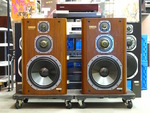
Additional topics: I have reported on my play with many of my handmade speakers, but when I presented a series of amp making course, I complained that I did not have a sufficient speaker system to reproduce the full-range sound with one amp. Remembering the lack at that time, I thought I would have to do something. Just then I got information on the DS-1000 shown on the photo below. It was on sale at Hi-Fi Do. Although the Diatone speaker has disappeared from the market, it was one of the most famous Japanese speakers! Previously I did not buy a speaker with a mid-range unit of cone type as a common speaker even if it was on sale frequently. But this DS-1000 has a mid-range unit of dome type. In addition, it uses boron that is a rare material, and voice coil bobbin and diaphragm are made by integral molding, which is attractive to an audiophile. Furthermore, it has a honeycomb cone woofer, to which I have referred in this column. So I negotiated on purchase of the speaker right away and was able to buy it. The president of Hi-Fi Do told the staff to deliver the speaker carefully because its diaphragm is delicate (actually I hear the president used a word "fragile" to the point). Then the speaker was delivered to my house by the delivery service staff of Hi-Fi Do who was accustomed to dealing with speakers. Honestly speaking, it gave me great confidence in the store that the president himself knew well on the goods and provided customers with appropriate services. Probably the staff too was studying hard about the goods, and I felt thankful to them. The president and staff of Hi-Fi Do were quite opposite to the president of the construction company currently being broadcast from the Diet. |
|

|
|
|
My role to play is the maintenance of this speaker. First of all, I wiped the dust off the speaker, waxed it, repaired the grain cabinet, and concealed spots with a colored marker. Finally, I polished the emblem on the saran net as a finish. |
|

|
|
 Used
Used Consigned
 Hold
Hold Reserved
 Sold Out
-
-
- Company profile
- Privacy policy
- Contact
- Newsletter back issues
- Hi-Fi Do live camera!
- Today's software
- Today's hardware
- New arrival alert system
- Japanese
-
Hi-Fi Do Online Newsletter
-
Payment methods

-
Shipping methods

-
Warranty policy

-
Shopping procedure

-
Hi-Fi Do Record Shops Softs, Audio parts and Tubes can ship overseas.Ordinary,we use EMS but for large order,we use SAL or Surface.For Asia,it cost 1,200JPY/1LP,900JPY/1CD.Please check at the shipping cost table for more detail.

-
Meaning of icons
