

Payment and point member | Payment methods | Shipping methods | Warranty policy | Shopping procedure


|
My audio and jazz history The 40th episode "KIMBER KABLE PK-14Gold: Part 4 – The Difference of IEC Connectors" By Kenji Kondo on November 11 Though I tried out several times the new PK-14G on a SACD player, the power cable I currently use was the best in tone quality and reproduced my most favorite sound. So I decided to regularly use the power cable of my own making on a SACD player. |
|
|
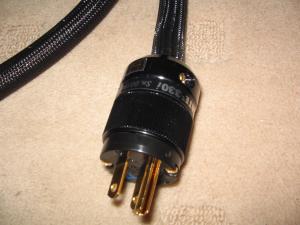
The power cable I have been using up to now on this SACD player was a perfect one, but I hit upon an idea to exchange only the IEC connector of the AC plug of the power cable. So I used a thick cable of Company A, the previously-mentioned WATTaGATE-330i for the AC plug, and the WATTaGATE-330 for the IEC connector which I obtained by asking my audio friend to order and which was an upgraded, custom-made, and silver-plated connector. This was a pretty expensive connector. I was concerned about both its performance and price. I was especially fascinated with the gorgeous, clear, and rich cymbal sound. In addition, it reproduced low-range compact bass sound and clear-cut piano sound in details. Jazz piano and drum sound was also clear and thick. Base sound too was deep with clear tones and sounded loud at a high velocity. I had an impression that each tone sounded without any difficulty and with wonderful high resolution. |
|
|
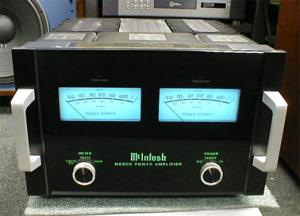
Then I decided to try out the new PK-14G more on a power amp or as a main cable between the wall outlet and the power tap. First, I tried to connect it to a McIntosh MC-602 power amp. "What happened?" I said to myself. Here again a difficult problem occurred. I could not insert the IEC connector of the PK-14G into the power amp. "What can I do?" I mumbled to myself dispiritedly. |
|
|
 |
|
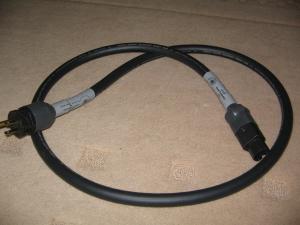
The currently-used IEC connector of the CARDAS Golden Reference AC plug was thin and long so it could easily be inserted into the power amp. However, the IEC connector of the PK-14G had the standard round shape that most makers currently adopted. It was difficult to insert this into the input port of the McIntosh MC-602 because the input port did not have enough space. But I never gave up and tried again to insert. It seemed that the connector managed to reach the amp in the slightest touch. But the connector was inserted obliquely and looking bad and unstable. I was scared when it would be disconnected. As is often seen, each cable maker covers its cables with a black tube. This again makes its connector even thicker, and as a result the connector cannot be connected at all to the McIntosh MC-602. After all, I hoped that the maker, McIntosh, would catch up with the current situation of the audio industry and would provide users with such products as they can use feeling at ease. To the end, I strongly request specs modification from the McIntosh so that the upcoming power amps to be marketed will be compatible with any type of connector of power cables. |
 Used
Used Consigned
 Hold
Hold Reserved
 Sold Out
-
-
- Company profile
- Privacy policy
- Contact
- Newsletter back issues
- Hi-Fi Do live camera!
- Today's software
- Today's hardware
- New arrival alert system
- Japanese
-
Hi-Fi Do Online Newsletter
-
Payment methods

-
Shipping methods

-
Warranty policy

-
Shopping procedure

-
Hi-Fi Do Record Shops Softs, Audio parts and Tubes can ship overseas.Ordinary,we use EMS but for large order,we use SAL or Surface.For Asia,it cost 1,200JPY/1LP,900JPY/1CD.Please check at the shipping cost table for more detail.

-
Meaning of icons
