

Payment and point member | Payment methods | Shipping methods | Warranty policy | Shopping procedure


|
My audio and jazz history, The 43rd episode, "That's why I can't quit being a audiophile!", by Kenji Kondo on December 2 The speaker as we know it today has the biwiring terminal as standard. It works in an ideal condition when this feature is used. If you are audiophile, you know about the biwiring system. It is a method separately connecting a speaker cable to the unit on low range (woofer) side and high range (tweeter) side each. This method started to be employed for British speakers 14 or 15 years ago. Presently, most speaker manufacturers around the world employ the biwiring system. The ideal biwiring system uses the method to connect the low range and other units separately. In this case, the crossover network should be also separated into the low range side and the high range side. This is why the speaker has a separate terminal each. Although it is ideal to use two cables of the same kind for biwiring, it may be impossible sometimes. Especially a kind of expensive cable is pretty large in outside diameter. Using two thick cables wouldn't look good and actually would become annoying. Moreover, it is difficult cost-wise to use two expensive cables. So, what's happening now is that they cover it with a single wire in most cases. |
|

|
 |
|
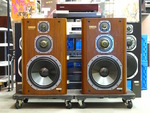
And then, what I tried this time was to use a conventional single wire standard cable and a jumper cable. My audio system gave me an emotional moment. As soon as I heard the sound, I was speechless at its reproducibility which I've never heard before. At that moment, I got filled with excitement and happiness. I regretted that I didn't try it much earlier than then, which was a connection method through the biwiring system of the speaker system (JBL4344MK2). Because I was stubbornly convinced for a long time that it is a rule with a speaker cable and for single connection in the biwiring case to connect from the low range (woofer) side for both + and – by using a high-performance jumper cable through that connection method. However I couldn't stop thinking that I should have tried as many things as possible by acquiring wide and good information. My first experience was when I tried to connect + and – of the cable, which was connected from the low range (woofer) side, from the high range (tweeter) side the opposite side. To my surprise, SN went up a lot more and also the resolution improved outstandingly. The outlook for high range and low/mid range feel got improved brilliantly. I thought "you never know your luck." And I got more interested in many kinds of biwiring connection since then. Because, this fact was underlying, which my ideal sound the well-firm bass with the deep low range feel couldn't be reproduced at all somehow. Since then I started looking for audio system of my dreams everyday for the high sound quality reproduction. (to be continued) |
|
 Used
Used Consigned
 Hold
Hold Reserved
 Sold Out
-
-
- Company profile
- Privacy policy
- Contact
- Newsletter back issues
- Hi-Fi Do live camera!
- Today's software
- Today's hardware
- New arrival alert system
- Japanese
-
Hi-Fi Do Online Newsletter
-
Payment methods

-
Shipping methods

-
Warranty policy

-
Shopping procedure

-
Hi-Fi Do Record Shops Softs, Audio parts and Tubes can ship overseas.Ordinary,we use EMS but for large order,we use SAL or Surface.For Asia,it cost 1,200JPY/1LP,900JPY/1CD.Please check at the shipping cost table for more detail.

-
Meaning of icons
